An Argument on Poetry
With this essay, I’m offering a perspective on shelter in the unbounded poetic space.
Part 1: The Definition of Poetry
In “A consideration of Poetry,” Kay Ryan characterizes poetry through humility in the absence of knowledge, i.e., T.S. Eliot’s “superior amusement.”
Many years after, Stepanova defines it as “the knife that cuts the fabric of reality”
A.R Ammons writes “a Poem is a Walk”
and Susan Sontag calls poetry “the work of the obsédé, the nut, the moron”.
With Sontag’s definition making it full circle back to “amusement pour distraire les honnêtes gen”, I love Ryan’s and Sontag’s “nonsense” definition the most.
Part 2: The Introduction of Unboundedness in Poetry
When I was twenty (and pretentious), I tried to describe the poetic task as an ultimate escape into singularity through a long and overly complicated hypothesis around M-theory, dark matter, and Stepanova’s “knife”.
I won’t do it now but will resort to Anne Carson’s work in “Plainwater”:
 Anne Carson, Mimnermos and the Motions of Hedonism
The luminous, otherwise unreproducible images triggered by decades of another’s life put into words define the time of its own. This is exactly what Ammons meant by calling a poem “a walk”: a unique experience, conditioned by one’s return.
This is the reason why a poem is a space, a time, and a perfect shelter.
The infinite life described by Carson, on the other hand, is nothing but the “unboundedness” of time. A feeling so familiar to anyone who has ever experienced loss, it constitutes the majority of my (and every other 20-something year old’s) reading.
Still, the concept of “unboundedness” in Carson’s writing creates a horrific concept — a shelter without limits is barely ever a shelter, but an infinite void:
But when the unboundedness comes after you, when you can’t escape it outwardly because it is already inside and already burning, you really have no shelter.
This is the question commonly asked by the last character left alive at the end of Greek tragedy: “Now where can I go”.
As soon as a non-Euclidean space opens the doors to new dimensions, the “unboundedness” sparks off the fear of an inability to define space and time, creating that absence of knowledge Kay Ryan mentioned — becoming the very embodiment of poetry.
Part 3: Unbounded Circles
The fear of unboundedness re-appears in the work of Terrance Hayes:
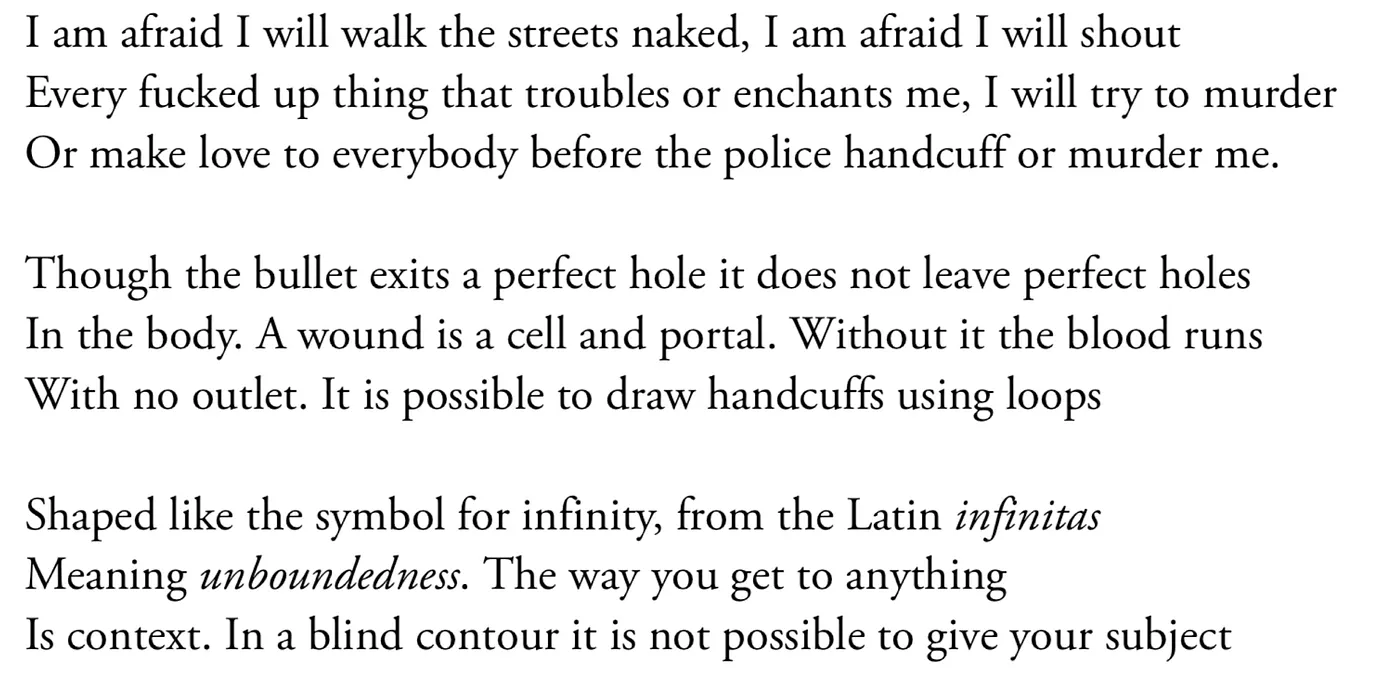 Terrance Hayes, How To Draw A Perfect Circle
Hayes talks about two bullet holes forming an infinite, handcuff-shaped cell and a portal within one’s body, replicating Carson’s biggest fear. The metaphor parallels the way Axemander described boundedness and unboundedness as justice and injustice, forming the entirety of the cosmos.
With this, unboundedness creates a dichotomy of life: the darker part of the cosmos inhabiting the words creates a bottomless space. Read: not exactly the safest shelter.
Not until we find true comfort in the ever-expanding space.
Hayes and Carson, however, were not the first to fall into the existential trap of unboundedness.
The renunciation of boundaries so eagerly adopted by poets had transpired into Emily Dickinson’s works, which, in my eyes, becomes the savior of the space.
My Business is Circumference.
She’d say. Yet,
My Business is to Love.
Not only did Dickinson idealize love to the point of erasing any limits to it, but she also used her works to put a reader to the edge of the unbounded space.
Hand in hand with Emerson’s “Circles”, they put unboundedness into a different light: the space for one to grow, move, and, above all, love.
The space defined by unboundedness reflects what a poem is: genuine, creative, and playful. Its all-consuming nature creates a home and puts it into an infinite space, turning a bottomless prison into the greatest refuge.